
Start typing here...
In many areas of Spain, totality will occur with the Sun only a few degrees above the horizon; for example, in different areas of Barcelona, the maximum will be around 20:29 with the Sun at about 4° above, while in the Balearics it may be even close to 2°.
🌅 1. Look for a completely clear west horizon
This eclipse will not be observed with the Sun high in the sky. It will take place very close to sunset, so a building, a mountain, a row of trees, or even a small rise in the terrain may obscure it at the most critical moment.
Choose a location in advance with a broad and unobstructed view towards the west-west/northwest. It is not enough for the sky to be clear above your head: what matters is having the lowest strip of the horizon free.
If you want to check the location in advance, visit the observation point one or two days before, approximately at the same time. The position of the Sun will be practically the same, and you can check if any obstacle blocks the sunset.
☁️ 2. Do not only focus on the overall percentage of cloud cover
For this eclipse, it will be especially important to know at what height the clouds will be.
Low clouds situated on the western horizon can completely hinder observation even if much of the sky is clear. A thin layer of high clouds, on the other hand, can allow for partial visibility of the phenomenon.
A few days before the eclipse, it is advisable to check separately:
low cloud cover + medium cloud cover + high cloud cover.
And during the afternoon of the 12th, complement the forecast with real-time satellite images to know where the clouds are moving.
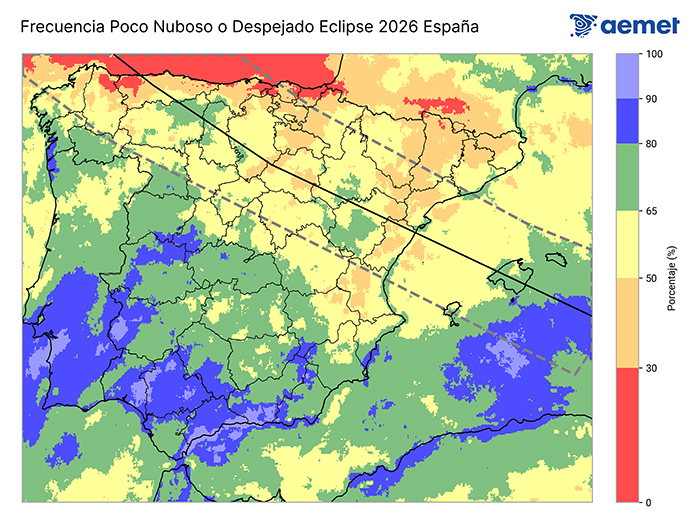
AEMET has specifically studied the climatology of cloud cover for those dates and times. Historically, the Cantabrian coast has a lower frequency of clear skies, approximately around a 30-50 %, while many inland areas and the Ebro valley are approximately at 50-70 %. This is not a prediction for the 12th, but it does show why it is worth having an alternative plan prepared.
🚗 3. Prepare a Plan A and a Plan B
If you really want to increase the chances of seeing it, do not decide on the final location too far in advance.
Have two or three observation points separated from each other, preferably with good access and a clear western horizon.
Between 24 and 48 hours before, compare the cloud cover forecast between them. And on the same day, if the conditions are doubtful, decide using the satellite images as well.
In a total eclipse, moving 50 or 100 km to avoid a band of clouds can make the difference between seeing it and missing it completely..
🌤️ 4. Clouds never replace eclipse glasses
That the Sun is near the horizon, behind haze or partially covered by clouds does not mean it is safe to look at it directly.
Use specific solar observation glasses during the partial phases. A cloud can temporarily reduce brightness and disappear seconds later.
Additionally, do not use eclipse glasses to look through binoculars, cameras or telescopes. These instruments concentrate solar radiation and require a specific solar filter installed in front of the lens.
🌑 5. Pay close attention if you are inside or outside the path of totality
This point is crucial.
Within the path of totality, glasses can only be removed during the brief moments when the Sun is completely covered by the Moon. As soon as the first bright point of the Sun reappears, they must be put back on immediately.
Outside the path of totality, glasses must not be removed at any time.
Although from certain locations the eclipse may reach an extraordinarily close magnitude to 1, if there is no real totality, a part of the photosphere remains visible and protection continues to be necessary.
🧭 6. Arrive well in advance
Do not wait until 20:20 to find a spot.
The eclipse will begin in much of Spain around 19:30-19:40, while the maximum phase will occur approximately around 20:28-20:33, depending on the location.
We recommend being at the observation point at least one hour before the maximum. This way you can check the horizon, set up your equipment calmly and observe how the ambient lighting changes progressively.
📷 7. If you are going to photograph it, do tests beforehand
The Sun will be very low and the contrast between the sky, the landscape and the solar disc will be very different from that of a conventional solar observation.
Prepare the framing in advance and use a suitable solar filter in front of the lens during the partial phases.
If you are going to observe from the totality area, the filter can be removed during totality to photograph the corona, but it must be placed back before the solar photosphere reappears.
🌫️ 8. Pay special attention to horizontal visibility
In this eclipse, it is not only the clouds that matter. The haze, aerosols, humidity and mist near the horizon can also significantly reduce visibility.
That is why it may be preferable to have a slightly elevated point with a clean atmosphere towards the west than an apparently perfect location but situated behind a city, an industrial area or a layer of sea mist.
⭐ Our main advice
For the 2026 eclipse, the observation location will be almost as important as the weather.
A good point should combine three conditions:
Being correctly situated with respect to the path of totality + having a completely clear western horizon + presenting a good forecast of cloud cover and visibility.
The IGN also offers information about the eclipse municipality by municipality, including time of maximum, height and azimuth of the Sun, so it is highly recommended to check the exact conditions of the chosen location in advance.